Why Precious Metal ID (PMid) Belongs on Every Handheld X-ray Imager
/ Aug 10, 2026
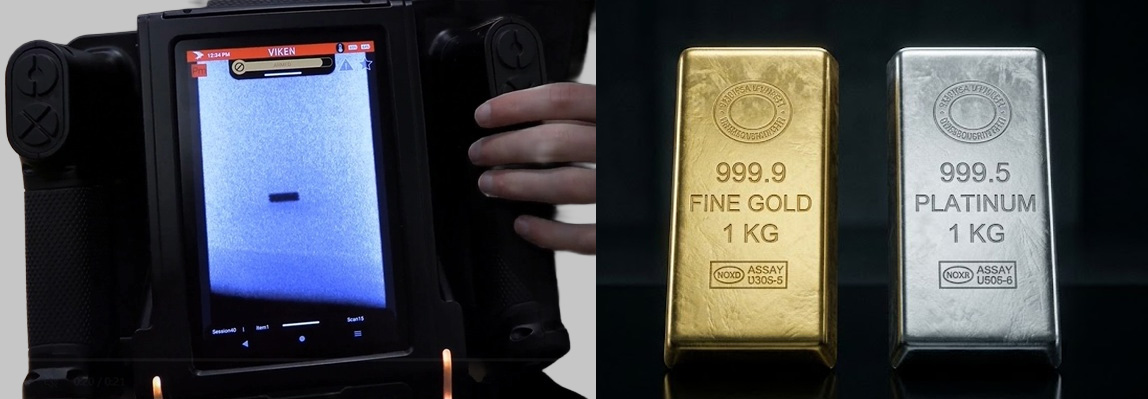
If you have worked on narcotics or interdiction long enough, you already know the search does not end when you find the dope. The money is the other half of the case, and the money is getting harder to find. Bulk cash still moves, but sophisticated organizations have learned that cash is bulky, traceable, and increasingly flagged at the bank. So, they convert. They turn illicit proceeds into something that holds value, crosses border quietly and does not trip the same alarms. Increasingly, that something is gold and platinum.
This is where Precious Metal PmID) on a handheld X-ray imager stop being a “nice to have” and becomes a real investigative tool.
The laundering problem you are up against
Gold and precious metals are attractive to launderers for the same reasons they have always been attractive to everyone else: stable value, high liquidity, and near-total anonymity. The Financial Action Task Force (FATF) has repeatedly flagged gold as an alternative vehicle for moving and storing criminal proceeds precisely because it is anonymous, easily transformed, and interchangeable.
The techniques are not exotic:
- Conversion and storage. Dirty cash is used to buy gold or platinum, which becomes a compact storage of value that can sit in a trap or ride in a load vehicle. A watch, a bar, or a handful of coins can replace a duffel bag of cash.
- Trade-based movement. Metals are shipped, over- or under-invoiced, and moved across jurisdictions to reposition wealth with limited transparency.
- Structuring and resale. High-value easily transported items are purchased below reporting thresholds and resold later with a veneer of legitimacy.
For the officer on the roadside or the investigator on a warrant, the practical problem is simple. A concealed pound of gold does not look like a pound of gold on a standard scan. Dense metal is dense metal. You need to know what the element is.
Why imaging alone is not enough.
A good backscatter image tells you something is there. It shows you the shape, the density, the anomaly behind the quarter panel or inside the battery box. That is essential, and it is what these tools do best. But an image cannot tell you the difference between a steel bracket, a lead trap, and a cache of gold. To make that call, you must work at the element level.
That is the core argument for PmID. It is not imaging. It is elemental identification using an onboard X-Ray Fluorescence (XRF) detector. On the Viken RAVEN, the same XRF sensor that powers lead detection analyzes the scan region for the specific signatures of gold (Au) and platinum (Pt), materials that rarely occur in normal vehicles, walls, or everyday cargo and are sometimes used by bad actors to move concealed payment for contraband. When a significant amount of gold or platinum is present, the operator gets an automatic alert. A red Pm icon appears in the corner of the screen, and the top banner turns red to draw attention. It is automatic, not a guessing game.
What this looks like in the field
Picture a highway interdiction stop. The load vehicle scans clean for large organic masses, but there is a dense anomaly tucked behind the rear seat. Image alone, you are not sure. With PmID running, the system flags gold in that region. Now you are not just looking at a suspicious shape, you have an elemental indicator pointing to concealed value, which changes how you build the stop, the questions you ask, and the case you hand to the prosecutor.
The same applies on a search warrant where you are looking for proceeds, not product, or in a corrections or facility environment where valuables are being moved improperly. The value is speed and certainty. You get an element-level indicator in the field, in seconds, without disassembly.
The bottom line for narcotics and laundering units
Interdiction and financial-crime work are converging. The same stop that yields the drugs is increasingly the stop that yields the proceeds, and those proceeds are being converted into metals to beat traditional detection. An imager that only shows you shapes leaves half the case on the table. Element-level identification closes that gap. PmID turns a dense unknown into a specific, actionable indicator of concealed value, and it does it in the field where you need the answer.
If you are evaluating handheld X-ray imagers for your mission, do not stop at image quality and penetration. Ask about what tools can identify at the element level.