Why the DTX Arm Belongs on Your Handheld X-Ray: Seeing the Whole Concealment, Not Just Half of It
/ Aug 11, 2026
Anyone who has worked at a roadside stop knows the frustration of a scan that is almost good enough. You put the X-Ray imager on the door panel, the quarter, the seat back, and you get a picture that tells you something is off, but not exactly what or how deep. You are making a call on partial information, with the clock running and a driver watching. That gap between “something looks wrong” and “I know what I am looking at” is where a lot of good stops fall apart.
The RAVEN DTX arm exists to close that gap.
Backscatter is great, but sometimes I need more.
Backscatter imaging is the workhorse of handheld X-ray, and for good reason. It excels at organics, the low-density material that makes up most of what we chase: powders, plant material, packaged narcotics. It reads the surface and near-surface layers, and it does not need access to both sides of the target, which is exactly what you want on a vehicle or a wall.
But physics is physics. Backscatter reads what bounces back, so it is strongest near the surface and weaker as you go deeper. It struggles with dense, layered, or metallic concealments, and it cannot always tell you what is sitting behind a thick steel panel or buried in a cluttered bag. Independent breakdowns of the technology say the same thing: backscatter is the better tool for organic threats near the surface, transmission is the better tool for structure and density, and in serious environments the two are deployed together.
That is the core argument for DTX. It is not a replacement for backscatter. It completes it.
What the DTX arm achieves.
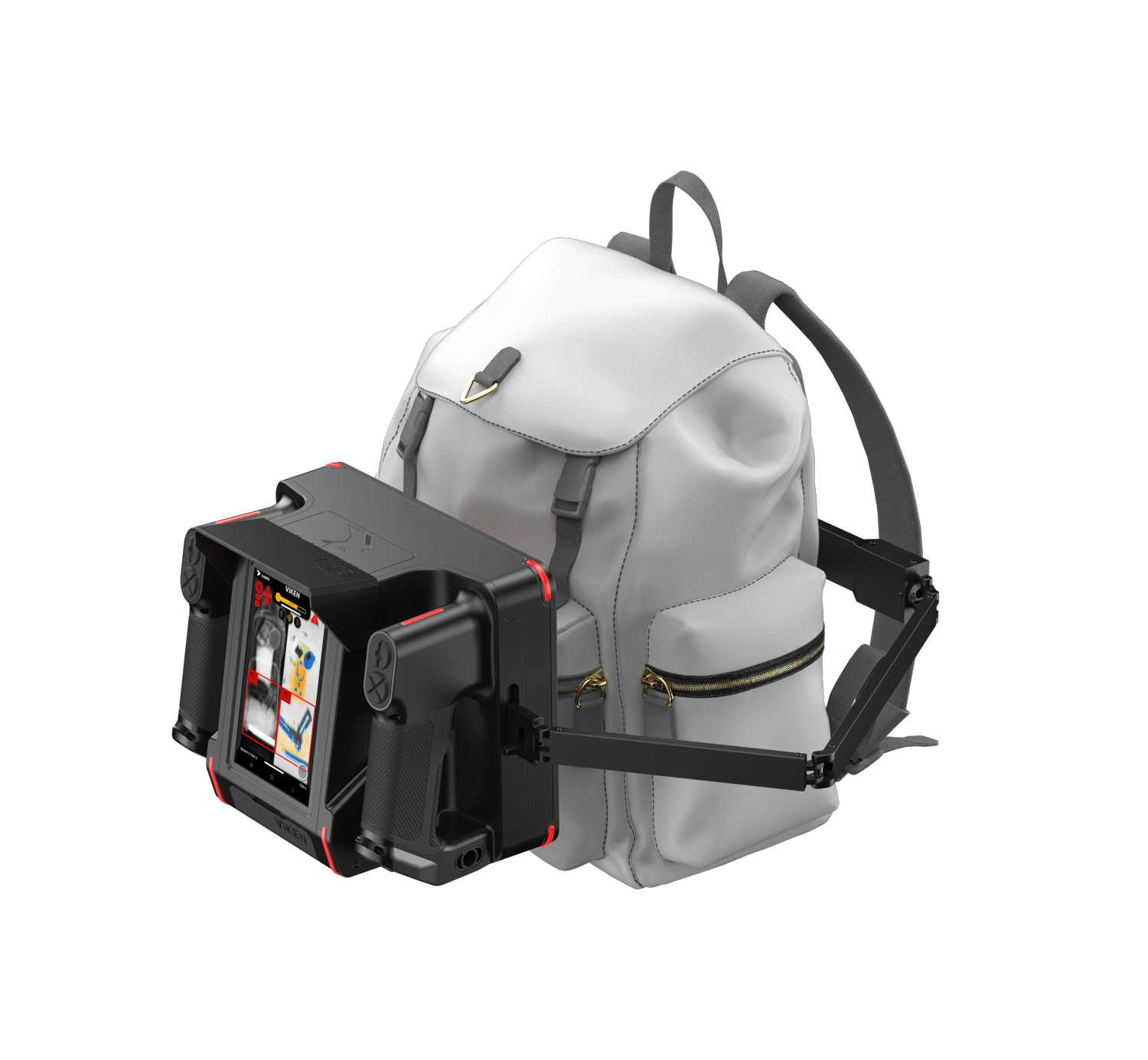
DTX stands for Dynamic Transmission X-ray. It is an optional articulating arm and bar that attaches directly to the RAVEN. You place the object between the RAVEN and the DTX bar, scan top to bottom, and the system automatically captures both backscatter and transmission data and displays them side by side. Transmission means the beam passes all the way through the target to the detector on the other side, giving you the density and internal structure view that backscatter alone cannot provide.
A few things that matter for interdiction work:
- Deep penetration. DTX delivers up to 40mm of steel penetration at 160kV and can be the difference between seeing into a packed engine bay or a dense trap and guessing at it.
- Metallic and layered targets. Transmission improves visibility into metallic threats, components, and concealment structures. On a mixed target like a loaded backpack or a suitcase full of clothing, it gives a clearer, more detailed picture of what is buried in the clutter.
- No panel to place. Because the bar is on the arm, you do not have to reach around and set a separate panel behind the object. This is unique to the integrated platform, and it saves time and exposure on every scan.
- Simultaneous, not either/or. You get organics from backscatter and structure from transmission in a single pass, side by side, so you are not switching tools or scanning twice.
What this looks like in the field
Picture the load vehicle again. Backscatter lights up an organic mass low in the door, which is your probable cause. But there is also a dense, boxy anomaly behind the panel that backscatter cannot fully resolve. Run the DTX and the transmission view show you the internal structure of that anomaly, the shape of a compartment, the density of what is inside, the metal framing around it. Now you are not just acting on a hunch, you have a clearer read on the concealment before you commit to a lengthy teardown.
The same applies to parcels and bags on a package interdiction detail, or to structural voids on a search warrant. Backscatter finds the organic hit; transmission tells you what the concealment is built out of and how deep it runs. That combination is what lets you prioritize, decide fast, and document the stop.
The bottom line for narcotics and interdiction teams
Traffickers build concealments to beat a single point of view. If your imager only reads the surface, you are working with half the picture, and half a picture is how good loads slip through and how good stops get challenged later. Transmission closes that blind spot. The DTX arm brings deep, dynamic transmission imaging to a handheld platform, in a single pass, without a separate panel, giving you organics and structure at the same time.
If you are evaluating handheld X-ray, do not stop at backscatter image quality. Ask what the tool can show you inside and behind the concealment. On the RAVEN, that answer is the DTX arm.